
The costs of integrating a CRM with other software come in three layers: the one-time setup, the monthly connector or middleware fees, and ongoing maintenance. Most quotes leave maintenance out. In the worked example below, five integrations on a middleware plan cost about $14,800 over three years, and roughly half of that is upkeep. Choose the integration path before you choose the CRM.
TL;DR:
- Integration cost has three layers: setup (once), connector or middleware fees (monthly), and maintenance (forever). Most quotes cover only the first.
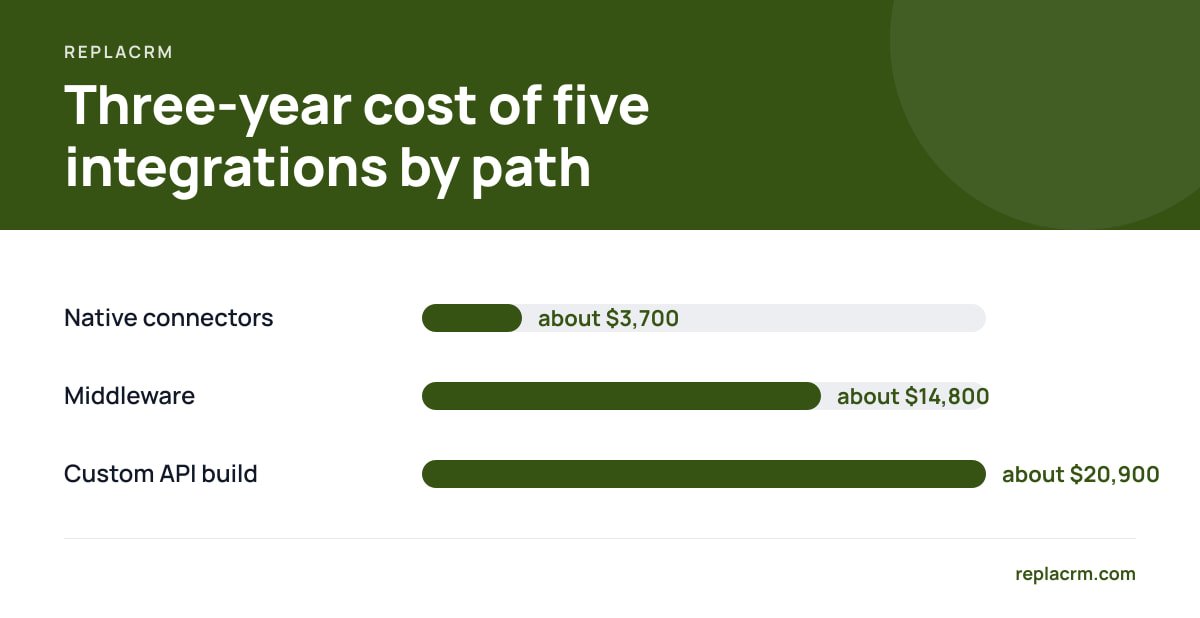
- In our three-year example, five integrations cost about $3,700 on native connectors, $14,800 on middleware and $20,900 on a custom API build.
- Linking a CRM to an ERP is routine. Decide up front which system owns the customer record, and sync only IDs, statuses and totals.
- Every connected app is a data processor under privacy law and an attack surface. Budget for the contracts and access reviews.
- A CRM that already holds chats, tickets, forms, email and calls on one record removes several integrations.
Table of Contents
- What Is the Cost of a CRM? The License Is Only One of Five Bills
- The Costs of Integrating a CRM With Other Software, Line by Line
- Native, Middleware or Custom Code: Which Integration Path Costs Least
- The 7 Components of a CRM and Where Each One Gets Expensive
- Can a CRM Be Integrated With ERP? Yes, and Here Is the Catch
- Who Competes With the Enterprise CRM Leaders, and Why It Changes Your Integration Bill
- Hidden Integration Costs: Privacy Contracts, API Security and Breakage
- Cut the Integration Bill by Keeping Customer Conversations in One Place
- Frequently Asked Questions
- Sources
What Is the Cost of a CRM? The License Is Only One of Five Bills
A CRM's cost has five lines: the license or subscription, integration setup, connector or middleware fees, maintenance, and data cleanup. Buyers compare the first line and get surprised by the other four. For the license figure on a ten-person team, see how much a CRM costs per year for 10 users. This article covers everything that sits beside that number.
Integration gets underestimated because a demo shows a connector switched on in two clicks. It does not show the field mapping, the duplicate contacts, the expired login token in month seven, or the afternoon someone spends working out why invoices stopped appearing on customer records.
If you are already trying to shrink the total, how to reduce CRM costs beyond the monthly subscription covers the other levers. Integration is the one people forget.
The Costs of Integrating a CRM With Other Software, Line by Line
The table below gives planning ranges. They are our estimates from typical small-business projects, not published benchmarks, so replace them with real quotes before you commit.
| Cost line | Planning range | How often |
|---|---|---|
| Discovery and field mapping | 4 to 12 hours | Once per integration |
| Native connector | $0 to $30 per month per app | Monthly |
| Middleware plan | $20 to $300 per month, scaling with task volume | Monthly |
| Custom API build | 40 to 150 developer hours | Once |
| Maintenance | 1 to 3 hours per month, or 10 to 20 percent of build cost per year | Ongoing |
| Data cleanup before the first sync | 5 to 30 hours | Once |
| Staff training | 1 to 2 hours per user | Once, plus turnover |
Three of these lines deserve a closer look:
- Data cleanup. Syncing two dirty databases produces one larger dirty database. Merging duplicates and standardizing phone and country formats before the first sync is cheaper than fixing them after. If you are also moving records between systems, the steps in migrating CRM data without losing history apply here too.
- Task-based pricing. Middleware charges by the number of automated actions. A sync that touches every contact on every update can burn through a plan in a week. Filter by trigger, such as "deal stage changed", instead of syncing everything.
- Maintenance. Apps rename fields, retire API versions and change permissions. Each change can break a sync without any error message, so plan for it as a recurring cost.
Native, Middleware or Custom Code: Which Integration Path Costs Least
Pick the native connector when one exists and covers the fields you need. Use middleware when you have a few integrations and no developer. Build custom only when volume or logic makes the other two painful. That is the order we would choose in, and the numbers show why.
Here is a three-year comparison for five integrations: email, accounting, helpdesk, web forms and calendar. The assumptions are $100 per hour for setup and upkeep, $120 per hour for a developer, and the maintenance figures shown.
| Path | Setup | Fees (36 months) | Maintenance (36 months) | Three-year total |
|---|---|---|---|---|
| Native connectors | $1,000 (10 hours) | $900 | $1,800 (0.5 hour per month) | about $3,700 |
| Middleware | $4,000 (40 hours) | $3,600 ($100 per month) | $7,200 (2 hours per month) | about $14,800 |
| Custom API build | $14,400 (120 hours) | none | $6,480 (15% of build per year) | about $20,900 |
Five integrations on a middleware plan cost about $14,800 over three years in this example, and $7,200 of that is maintenance.
Native connectors cost least but only cover what the vendor decided to support. Middleware is flexible but unpredictable, because task counts grow with your business. Custom code has the highest floor and the fewest surprises, since you control the logic.
Pro Tip: Authorize every integration with a dedicated service account, never a staff member's personal login. OAuth 2.0, the framework defined in IETF RFC 6749, issues access tokens with limited lifetimes and renews them through a refresh token tied to the account that authorized the connection. When that employee leaves and their account is disabled, the sync dies. Also create one test contact and check monthly that it appears correctly in every connected system. That catches silent failures in minutes.
When you evaluate a vendor's API, ask whether it publishes a machine-readable description in the OpenAPI Specification. A documented API lets a developer scope the work accurately. With an undocumented one you pay for exploration. It is also worth checking how stable the vendor is, because a vendor that retires its API on short notice hands you a rebuild bill.
The 7 Components of a CRM and Where Each One Gets Expensive
Sources vary on the exact list, but a CRM is commonly split into seven components. Each one has a different integration profile.
| Component | Usually connects to | Where the cost hides |
|---|---|---|
| Contact and account management | Email, accounting, ERP | Duplicates and conflicting records |
| Sales pipeline and deal tracking | Quoting, e-signing, accounting | Stage names that mean different things in each tool |
| Interaction history (email, calls, chat) | Phone system, inbox, chat widget | Volume. Every message is a record |
| Customer support and ticketing | Helpdesk, knowledge base | Two-way sync of status and ownership |
| Scheduling and bookings | Calendar, video, payments | Time zones and double bookings |
| Lead capture and marketing | Forms, ad platforms, email tools | Consent flags and source attribution |
| Reporting and automation | Spreadsheets, BI tools | Maintaining definitions across systems |
Components built around many-to-many data, meaning interaction history and support, cost the most to connect. Those with a single source of truth, such as bookings, cost the least. If you are deciding which components you need at all, the CRM features small sales teams need separates the essentials from the extras.
Can a CRM Be Integrated With ERP? Yes, and Here Is the Catch
Yes. Linking a CRM to an ERP is one of the most common integrations, and it takes one of three forms: a vendor-supplied connector, middleware, or a custom API build. Expect the high end of the ranges above, because ERP data models are large and strict.
The cost driver is the decision, not the code. You have to settle which system owns each type of data:
- Customer identity. One system creates the customer. The other receives it. If both can create, you will have duplicates within a month.
- Products and prices. Usually the ERP owns these. The CRM reads them when building quotes.
- Orders and invoices. The ERP owns them. The CRM should show totals and payment status on the customer record, not copy every line item.
- Credit and payment status. Sync this one-way from ERP to CRM so salespeople see overdue balances before they call.
Our advice is to start one-way, ERP to CRM, for payment status and order totals. Add the reverse direction only when a specific workflow demands it. Two-way syncs are where most ERP integration budgets overrun, because every conflict needs a rule.
Who Competes With the Enterprise CRM Leaders, and Why It Changes Your Integration Bill
The market leaders in enterprise CRM face competition in four categories, and each one prices integration differently.
- Other large enterprise suites. They sell a broad platform with its own marketplace of add-ons. Integration is often paid per connector or per API call tier, and the line items add up. We itemize that in the true cost of enterprise CRM add-ons.
- Mid-market all-in-one platforms. They bundle sales, marketing and service. You need fewer integrations but pay for modules you may not use.
- Small-business pipeline tools. They are cheap per seat and rely on middleware for anything beyond email and calendar.
- Self-hosted and open options. You pay once or pay for hosting, own the database, and can reach it directly. The trade-off is that you run the server.
Brand price matters less than how many separate tools your customer data lives in. Every extra tool is an extra integration.
Hidden Integration Costs: Privacy Contracts, API Security and Breakage
Each connected app that touches personal data creates legal and security work that rarely appears on a quote.
Under the EU's General Data Protection Regulation, Article 28 requires a binding contract whenever a processor handles personal data on your behalf.
Every app wired into your CRM that handles customer data is a processor under GDPR Article 28, and each one needs a written contract.
Even if you are not in the EU, many US state privacy laws and your own customers' contracts ask similar questions. Keep a list of every connected app and what data it receives.
On the security side, the OWASP API Security Top 10 lists broken object-level authorization as its first risk. In plain terms, an integration with a broad API key can often read records it should never see. Budget a quarterly review of which keys exist, what they can reach and who holds them.
Breakage is the third hidden cost. When a sync fails, someone has to notice. If nobody owns the monitoring, a customer finds the error. Give each integration a named owner and an alert that goes to a real inbox.
Cut the Integration Bill by Keeping Customer Conversations in One Place
Most of the integrations in our example exist to move chats, tickets, forms, email and calls into one record. Replacrm is a self-hosted CRM that already holds all of them on a single customer record, so those connections are not a recurring cost. It also keeps each brand's customers separate under one login, and adds a sales board, customer self-booking, e-signing, and calling and texting. It connects directly to ReplaChat and ReplaTicket. The price is a one-time payment from $1,495, with no per-user fees and unlimited brands, users and customers.
Replacrm does not remove every integration. Accounting software, an ERP or a payment processor still has to be connected, and the cost lines above apply to those. You also host it yourself, so server updates and backups are your responsibility. Check the spec sheet for the connections you need, ours included, before you buy.
Frequently Asked Questions
What is the cost of a CRM?
A CRM has five cost lines: the license or subscription, integration setup, connector or middleware fees, maintenance and data cleanup. The license is the visible one, and for a small team the others can match it within a few years. The per-user license figure is covered in our guide to a ten-user CRM's yearly cost.
What are the 7 components of CRM?
A common breakdown is contact management, sales pipeline, interaction history, customer support, scheduling, lead capture and marketing, and reporting. Lists vary by source. Interaction history and support usually cost the most to integrate, because many records move in both directions.
Can CRM be integrated with ERP?
Yes, through a vendor connector, middleware or a custom API build. The biggest cost is deciding which system owns customers, products, orders and payment status. Starting with a one-way sync from ERP to CRM keeps the budget under control.
Who are the main competitors of the enterprise CRM leaders?
They fall into four groups: other large enterprise suites, mid-market all-in-one platforms, small-business pipeline tools and self-hosted options. Each group prices integration differently, so compare the number of separate tools you would need to connect as well as the license price.
How much should I budget each year to maintain CRM integrations?
A practical planning figure is one to three hours per month per integration for middleware or native connectors, or 10 to 20 percent of the original build cost per year for custom code. Treat these as estimates and adjust after your first year of actual fixes.
Is middleware cheaper than a custom integration?
Over three years in our example, middleware cost about $14,800 against roughly $20,900 for a custom build, for five integrations. Middleware gets more expensive as task volume grows, so a high-volume workflow can tip the balance toward custom code.
Sources
- General Data Protection Regulation (EU) 2016/679 | EUR-Lex, European Union
- OWASP API Security Top 10 | OWASP Foundation
- RFC 6749: The OAuth 2.0 Authorization Framework | IETF
- OpenAPI Specification | OpenAPI Initiative
Leave a Reply