
An open source HubSpot alternative gives you the source code to inspect, modify, and host yourself, instead of renting access to a vendor's servers. The distinction that matters most isn't "open source vs. proprietary" — it's who controls the data and who absorbs the hosting work. Some open source CRMs hand you both the code and the server burden; others, like self-hosted but closed-source systems, skip the code access but still let you own the data without per-seat fees.
TL;DR:
- "Open source" means you can see and change the code — it doesn't automatically mean cheaper or easier to run.
- HubSpot's per-seat pricing scales with headcount, not with how much CRM work actually happens.
- Self-hosting (open source or not) shifts hosting and backups to you, in exchange for owning the data outright.
- The real buyer question is control over your customer data, not ideology about licensing.
- A one-time-license self-hosted CRM can deliver HubSpot's core workflow — contacts, inbox, pipeline — without monthly per-user bills.
Table of Contents
- Open Source, Self-Hosted, or Just Cheaper: Pick the Right Fight
- What "Open Source" Buys You, and What It Doesn't
- Where HubSpot's Per-Seat Model Starts to Hurt
- Comparing the Three Real Options
- The Open Source Route: What You're Signing Up For
- Questions to Ask Before You Migrate Off HubSpot
- Get a CRM You Own, Not Rent, From $1,495
- Frequently Asked Questions
- Sources
Open Source, Self-Hosted, or Just Cheaper: Pick the Right Fight
People searching for an "open source HubSpot alternative" are usually chasing one of three different things, and they're not the same fight. Some want the source code itself — to audit it, fork it, or make sure no vendor can ever lock them out. Others just want off the per-seat invoice and don't care whether the code is public, as long as the data sits on a server they control. A smaller group wants both: open code and self-hosting.
That distinction matters because open source and self-hosted are not synonyms. A tool can be open source and still require you to host it on a cloud instance you rent monthly. A tool can be fully self-hosted — running entirely on your own server — without publishing a single line of its source code. If what you actually want is to stop paying per user and start owning your customer records, the "open source" label is a means, not the goal.
Open source tells you who can read the code. Self-hosted tells you who holds the data. They answer different questions.
What "Open Source" Buys You, and What It Doesn't
The Open Source Initiative's definition requires that the source code be freely available, modifiable, and redistributable without discriminatory restrictions. That's a licensing guarantee, not a hosting guarantee, and not a feature guarantee.
- Code transparency. You or a contractor can read exactly how the CRM stores and processes data, instead of trusting a vendor's privacy page.
- No vendor lock on the code itself. If the project is abandoned, you still have the source to maintain or fork.
- Not automatically free to run. Most open source CRMs still need a server, a database, backups, and someone to patch security issues — that's ongoing labor, even if the license cost is zero.
- Not automatically simpler. Community-maintained open source tools often ship with rougher onboarding than a funded commercial product, because documentation and support aren't the product being sold.
- Not automatically more secure. Open code means more eyes can find bugs, but it also means attackers can read the same code. Security depends on who's patching it, not on the license.
If your actual goal is avoiding seat-based billing and keeping customer data off a third party's servers, a closed-source but self-hosted CRM can satisfy that goal just as well as an open source one — sometimes with far less setup work. ReplaCRM takes that route deliberately: closed source, but self-hosted on your own server, under a single one-time license.
Where HubSpot's Per-Seat Model Starts to Hurt
HubSpot's pricing scales with the number of people who need a login, not with how much actual CRM work your business does. Check HubSpot's own pricing page and you'll see the jump from a small team plan to a mid-size one is driven almost entirely by seat count, with features bundled in tiers you may not need yet.
This hits a specific kind of business hardest: owners running two, three, or more brands under one roof. Every brand on HubSpot typically means either a separate portal (separate bill) or crammed contact lists inside one portal, with no clean wall between Brand A's customers and Brand B's customers. Add a few seasonal staff or contractors who only need CRM access for a few months, and the per-seat math gets worse every quarter, not better.
Pro Tip: Before comparing sticker prices, add up what you're paying per contact record touched per month, not per seat. A five-seat HubSpot plan with 200 contacts and a two-seat self-hosted CRM with 20,000 contacts are not competing products — they're solving different problems, and the per-seat number alone will mislead you.
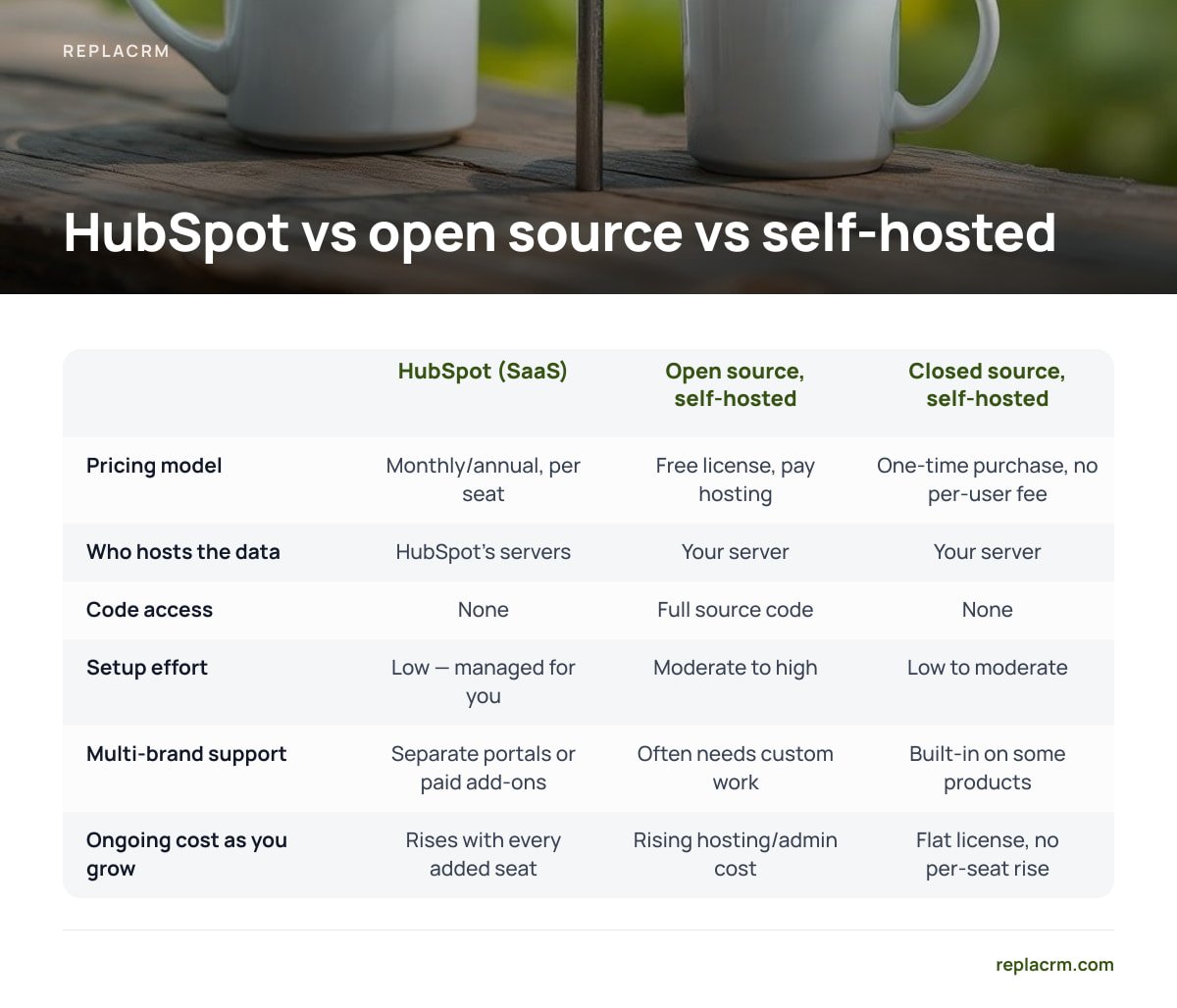
Comparing the Three Real Options
| HubSpot (SaaS) | Open source, self-hosted | Closed source, self-hosted (one-time license) | |
|---|---|---|---|
| Pricing model | Monthly/annual, per seat | Free license, you pay for hosting + maintenance | One-time purchase, no per-user fee |
| Who hosts the data | HubSpot's servers | Your server | Your server |
| Code access | None | Full source code | None |
| Setup effort | Low — managed for you | Moderate to high — you manage updates, security patches | Low to moderate — vendor builds it, you run it |
| Multi-brand support | Usually separate portals or paid add-ons | Depends on the project; often needs custom work | Built-in on some products |
| Ongoing cost as you grow | Rises with every added seat | Flat license, rising hosting/admin cost | Flat license, no per-seat rise |
Read this table for what it is: a map of trade-offs, not a verdict. If your team has in-house engineering capacity and wants to modify the CRM's core logic, open source self-hosting is a legitimate, powerful choice. If you want the self-hosting benefits — no per-seat bill, data on your own server — without taking on code maintenance, a closed-source self-hosted product is the shorter path.
The Open Source Route: What You're Signing Up For
If you go the open source self-hosted path, budget for three ongoing jobs that the license fee doesn't cover.
- Security patching. Someone has to track CVEs against the CRM and its dependencies (the database, the web server, any plugins) and apply patches promptly. Unpatched open source software is a common entry point for breaches, precisely because the vulnerable code is public.
- Backups and disaster recovery. Self-hosting means you're the backup team now. A server failure with no tested restore plan can mean losing every customer record you have.
- Upgrades. Community projects release new versions on their own schedule. Skipping versions for a year or two can turn a routine upgrade into a multi-day migration project.
None of this is a reason to avoid open source — plenty of businesses run it well. It's a reason to be honest about whether "free license" actually means "free," once you count the hours.
Questions to Ask Before You Migrate Off HubSpot
Before signing anything — open source, self-hosted, or otherwise — get specific answers to these, in writing if it's a vendor:
- Where does the data physically live, and who can access the server? If the answer is "our cloud, trust us," that's a SaaS product with extra steps, not a self-hosted one.
- What happens to my data if I stop paying or stop using the vendor? With a one-time license, the answer should be: it stays on your server, forever, because there's nothing left to pay.
- Can I separate customer records by brand under one login? Many CRMs — open source and commercial alike — assume one business per account and bolt on multi-tenancy as an afterthought.
- Who patches security issues, and on what schedule? Get this in writing for open source projects especially, since "the community" isn't a person you can call.
- Does it replace my existing stack, or just add to it? A CRM that doesn't pull in chats, forms, and calls just becomes one more tab, which defeats the point of consolidating off HubSpot in the first place.
For a deeper look at what running your own server actually involves day to day, see our breakdown of what a self-hosted CRM is and why it beats per-seat pricing, and our guide to self-hosted open source CRM options specifically.
Get a CRM You Own, Not Rent, From $1,495
ReplaCRM is built for the business owner who wants off the per-seat treadmill without taking on open source code maintenance. It's self-hosted on your own server, sold as a one-time license starting at $1,495, with no per-user fees and no limit on brands, users, or customers. It pulls chats, tickets, forms, email, and calls into one customer record, keeps each brand's customers separate under a single login, and adds a sales board, self-booking, and e-signing on top.
The honest trade-off: it's closed source, so you're not getting a codebase to fork or audit yourself — you're getting a product someone else maintains, running on hardware you control. If code transparency is the non-negotiable part of "open source alternative" for you, an open source project is the right fit. If what you actually want is to stop the monthly bill and keep the data, check the spec sheet against your brand count and current HubSpot invoice before you decide either way.
Frequently Asked Questions
Is there a true open source HubSpot alternative?
Yes, several open source CRM projects exist with publicly available source code that you can self-host and modify. They typically require you to manage your own server, security patches, and backups, since there's no vendor doing that work for a license fee.
Is open source always cheaper than HubSpot?
The license is often free, but hosting, security maintenance, and staff time to run it are not. For a small team without in-house engineering capacity, a paid self-hosted product with a one-time license can end up cheaper overall once labor is counted.
Can I self-host a CRM without it being open source?
Yes. Self-hosting describes where the software runs (your server) and open source describes whether the code is public. A CRM can be closed source and still run entirely on your own hardware, with no per-seat subscription.
What's the biggest hidden cost of open source CRM self-hosting?
Security patching and upgrades. Someone needs to track vulnerabilities in the CRM and its dependencies and apply fixes promptly, since publicly available code means attackers can study it too.
Does switching off HubSpot mean losing my contact history?
Not if you export properly first. Most CRMs, including HubSpot, support CSV exports of contacts, deals, and notes, but confirm field mapping and attachment handling with your new CRM before you cancel the old plan.
Sources
- The Open Source Definition | Open Source Initiative
- HubSpot Pricing | HubSpot
- Self-Hosted CRM: What You Own, What You Run, What It Costs | Replacrm
- Self-Hosted Open Source CRM: What You Own and What You Run | Replacrm
Recommended
- Self-Hosted CRM: What You Own, What You Run, What It Costs
- Self-Hosted Calendly Alternative: Own Your Bookings, Skip Seats
- On-Premise CRM for Small Business: Own Your Data, Skip Seat Fees
- Self-Hosted Open Source CRM: What You Own and What You Run
- The True Cost of Salesforce Add-Ons, Line by Line
- CRM Features Small Sales Teams Need (and the Ones You Don't)
- How to Vet CRM Vendor Stability Before You Switch
Leave a Reply